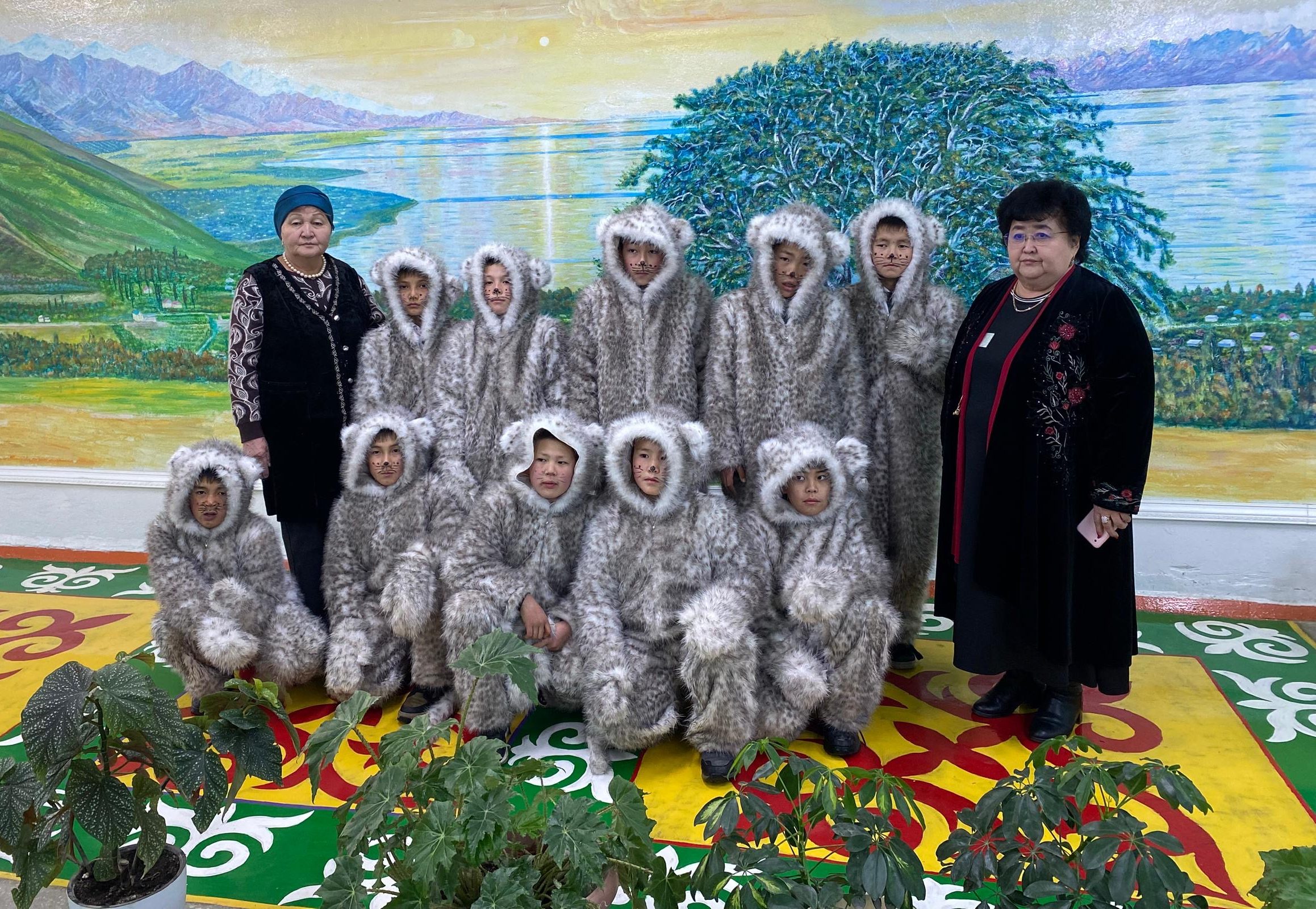
Zhypar Kurmanalieva, recipient of the Excellence in Education award with students from the Murok Environmental Club. Credit for All Photos: Land of the Snow Leopard Network (LOSL)
VOICES OF SNOW LEOPARD GUARDIANS: Stories from Kyrgyzstan
The personal story of Zhypar Kurmanalieva, told in the first person.
Narrated by: Zhypar Kurmanalieva
Recorded and prepared for publication by: Aigerim Zholchubekova
Translated from Kyrgyz with the narrator’s voice preserved.
I was born on 5 April 1959 in Ak-Shyyrak, the homeland of the snow leopard.
My parents worked at the meteorological station in Ak-Shyyrak. At that time, there were no satellites like the ones we have today. Meteorological stations operated in different mountains, gorges, and valleys, transmitting the data they collected to the meteorological centre in Moscow.
The house where we lived was the only one on one of the mountains of the Ak-Shyyrak Range. Not far from us was the Uch-Koshkon Geological Mining Complex, where tin was extracted.
Several livestock-herding families lived in the nearby gorges and valleys. Because they had lived there for many years, they were considered local residents.
Several times a day, my father and mother measured the temperature and took water measurements using an instrument that looked like a large ladle. I always went with them.
A suspension bridge stretched across the Ak-Shyyrak River. We would walk along it almost to the middle of the river. I did not fully understand what exactly my parents were measuring. I simply loved going out onto that suspension bridge.
If you looked down from it at the churning Ak-Shyyrak River for a long time, after a while your head would begin to spin and you would feel as though you were flying. I especially loved that feeling. I imagined myself flying across the entire universe.
After taking the measurements, my parents returned to the station and transmitted the collected data from a room filled with radio equipment.
Mountain ranges stretched along both sides of the river, while the Ak-Shyyrak River roared and churned between them. The landscape was extraordinarily beautiful. There were almost no tall trees or shrubs, but in summer the grass grew thick and all kinds of flowers bloomed everywhere.
Perhaps my love of nature began at that very time, in early childhood, born of a child’s pure feelings and impressions.
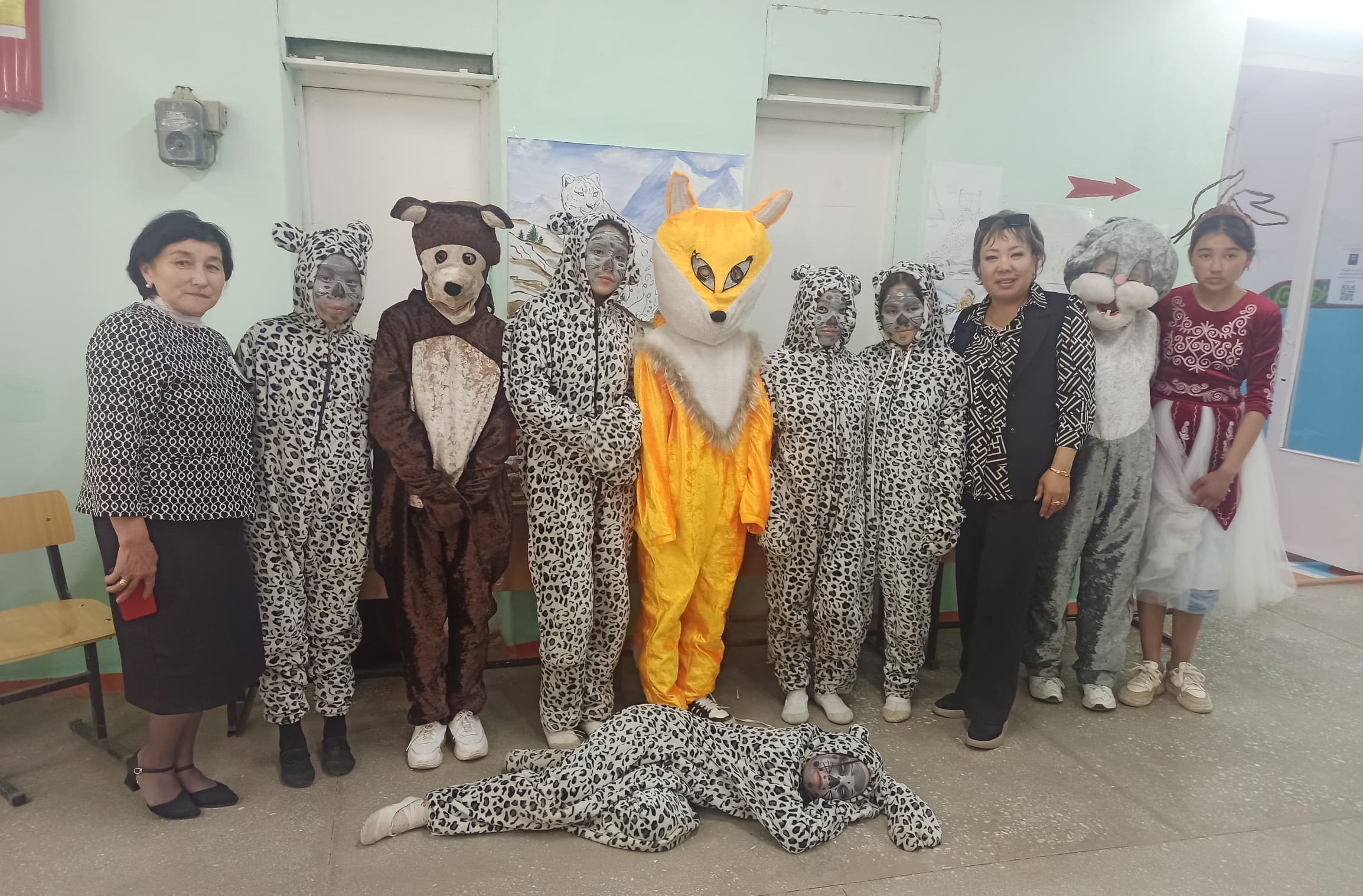
Students from the Murok Environmental Club performing in skits about protecting snow leopards.
After work, my father would put me on a horse, and we would visit other livestock herders. Those high-altitude areas are called syrt. Because so few people lived in those places, everyone was especially friendly and hospitable.
On the way there and back, I constantly asked my father all kinds of questions.
My father graduated with honours from a technical college in Semipalatinsk. He was a well-educated man and read a great deal. He answered every one of my questions patiently, thoroughly, and in detail.
The climate of Ak-Shyyrak was very harsh. There was not much snowfall in winter, but the frosts were extremely severe.
I lived there with my parents until I was three years old. Then my grandmother took me to the lakeside, where it was warmer, telling my parents that such a harsh climate would ruin the child’s health.
After that, I did not return to high-altitude Ak-Shyyrak until I was six years old.
I remember that journey very well.
It was probably in March or April, during the spring school holidays. The livestock herders’ children were flown to their parents by helicopter or plane. My father came and took my grandmother and me along with them.
That was the first time in my life that I had flown in a helicopter.
There were about ten or fifteen children and adults in the spacious front section of the helicopter. In the back were books, newspapers, magazines, bales of hay, and other supplies.
We took off from the city now called Karakol, which at the time was known as Przhevalsk. About an hour later, we arrived in Uch-Koshkon, where the helicopter landed.
From there, my father took us on horseback to the meteorological station.
My mother was waiting for us with the table laid. Russian specialists from Leningrad, Viktor and his wife Emma, lived at the station with my parents. Emma always gave me extraordinarily beautiful dolls and a toy dancing bear.
By the time we had finished dinner, it was already dark. My father was about to go outside, and I followed him.
That was when my first, unforgettable encounter with snow leopards took place.
When we stepped outside, other, even higher mountains rose opposite the mountain on which our house stood.
I looked in that direction and saw many glowing lights. Soft sounds came from there, resembling both growling and meowing at the same time.
It looked rather like a concert today, when the lights are turned off and people switch on the flashlights on their phones.
There were so many glowing eyes. In those days, there really were far more snow leopards.
I was terrified and began to cry. My father, who had already walked some distance away, ran back to me.
“What is that? I’m scared,” I said.
My father began to reassure me:
“Don’t be afraid, my dear. Those are snow leopards. They will not harm us. On the contrary, they watch over and protect us.”
I was still afraid, but I stopped crying.
When we returned to the house, my father said:
“I will tell you about snow leopards.”
He explained that snow leopards are the masters of these mountains.
The Kyrgyz people regarded the snow leopard as a sacred animal. People believed it to be an almost magical and mysterious creature living between heaven and earth. For that reason, they tried not to call it by its name directly and instead respectfully called it “jaabars.”
It was believed that anyone fortunate enough to see a living snow leopard was an exceptional person who would be blessed with good fortune and happiness in life.
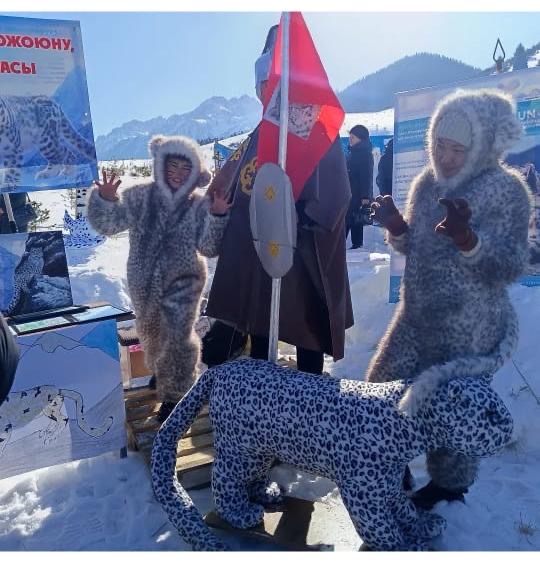
Students from the Murok Environmental Club attending snow leopard protection events.
The snow leopard truly is the master of these mountains. It is a very noble and restrained predator. It does not kill more mountain animals than it needs.
But, sadly, the snow leopard itself was in danger.
“Why?” I asked.
My father told me that adults had come to consider it prestigious to wear coats made from snow leopard fur. So hunters set traps, caught snow leopards, and sold them.
That night, I could not fall asleep for a long time and kept thinking about the snow leopards. I had seen only their glowing eyes and tried to imagine what they looked like in full.
A few days later, a man arrived at our home on horseback. He was a local resident named Duyshobek.
He placed a large object that looked like a box beside the house.
My mother invited him in:
“Aba, please come inside and have some tea.”
He came in. As they drank tea, my father asked:
“Well, Duyshoke, where are you coming from?”
He replied:
“I set a trap for a snow leopard. Today I was lucky. A very beautiful snow leopard was caught in the trap. I am taking it with me now.”
My heart began to pound.
I immediately thought, “So this is the bad hunter my father told me about.”
I sat motionless in the corner and did not even come to the table for tea. I was only six or seven years old at the time, but I still remember that moment very clearly. Perhaps it is because it made such a powerful impression on me.
When the adults had finished their tea, they went outside to look at the snow leopard. I followed them.
They said that the snow leopard was not very large, although it seemed enormous to me.
The beauty of its coat and of the animal itself has remained in my memory forever.
After that, I never saw a living snow leopard again. I saw them only in films and photographs.
From that day on, Duyshobek became a bad person in my eyes.
He often rode past and stopped by our home. When my mother asked:
“Who is that?”
I would answer:
“That same bad person.”
My mother would stop me:
“Oh, don’t say that. It isn’t nice.”
But as a child, I disliked him intensely, and so he has remained in my memory as a bad person.
Perhaps I developed such a special bond with nature because I was born and lived in such a beautiful place, among mountains and wild animals, where snow leopards made their home.
When I grew up and finished school, I enrolled in the geography faculty of an institute. I qualified as a geography and biology teacher and devoted my entire life to teaching and educating children.
I always placed special emphasis on fostering a caring and respectful attitude toward nature.
I lead the Murok Environmental Club, which is known not only throughout Kyrgyzstan but also beyond its borders. I have led it for more than 30 years. Over that time, several generations of students have passed through the club.
To this day, the snow leopard remains a magical and sacred animal to me.
This is the very attitude toward the snow leopard that we continually pass on to children and celebrate through the activities of our environmental club.

Zhypar Kurmanalieva with students at the Summer Camp, Chon-Kemin.
